01 overview02 research methods03 execution04 analysis & key insights01 overview02 research methods03 execution04 analysis & key insights
01 overview02 research methods03 execution04 analysis & key insights01 overview02 research methods03 execution04 analysis & key insights
back to all projects
01 overview
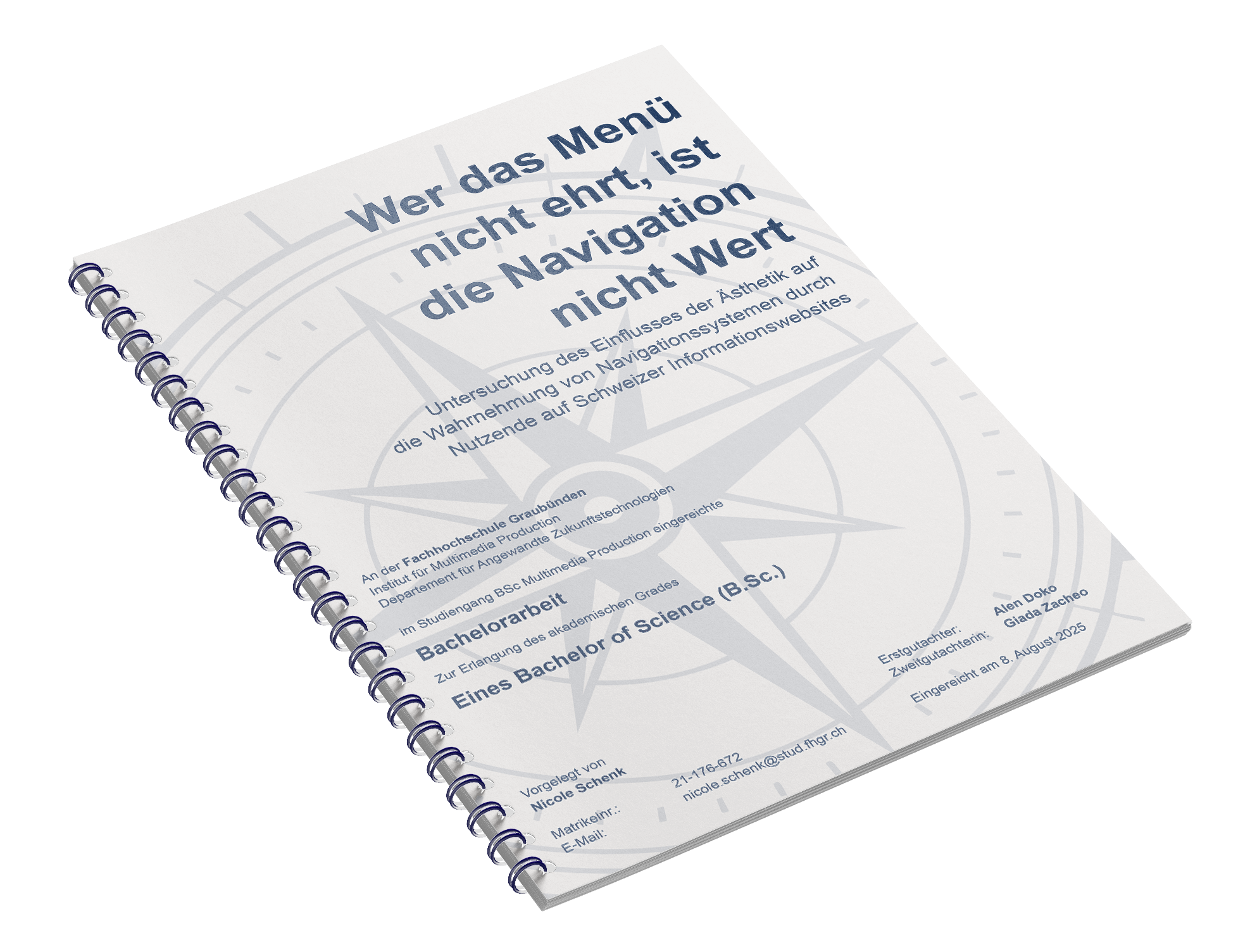
My bachelor thesis explores the relationship between visual aesthetics and navigation usability on swiss informational websites. The project investigates how design elements such as color, typography, and animation influence users’ perception of orientation, clarity, and overall usability within navigation systems.
The central research question focuses on whether aesthetic design can enhance perceived navigation quality. The study contributes to UX research by isolating navigation as a design element and examining it within the specific context of swiss information-driven websites.
02 research methods
The thesis follows a mixed-methods approach combining quantitative and qualitative UX research methods.
First, a systematic content analysis of 50 Swiss informational websites was conducted to identify common navigation patterns, usability standards, and aesthetic conventions. The analysis covered both functional criteria (e.g. visibility, consistency, orientation aids) and visual design factors (e.g. color usage, typography, animations).
Based on these findings, an empirical A/B test was designed to validate the observed patterns in a controlled environment.
03 execution
For the experimental phase, three navigation prototypes were created for a fictional informational platform. Each version combined different levels of usability quality and aesthetic refinement:
good usability with conventional aesthetic
poor usability with expressive aesthetics
good usability with expressive aesthetics
Participants completed moderated usability tasks while interacting with the different navigation variants. Their behavior, orientation, and subjective perception were recorded to assess how design decisions affected the navigation experience.
04 analysis & key insights
The results show a clear correlation between visual aesthetics and perceived usability. Well-designed visual elements improve orientation, support cognitive processing, and positively influence user satisfaction. In some cases, appealing aesthetics partially compensated for functional shortcomings, although the strongest results occurred when usability and aesthetics worked together. The findings underline that navigation is not purely functional: visual clarity, consistency, and aesthetic coherence play a crucial role in how users experience and understand navigation systems.
thank you for visiting i hope you enjoyed your staythank you for visiting i hope you enjoyed your staythank you for visiting i hope you enjoyed your staythank you for visiting i hope you enjoyed your staythank you for visiting i hope you enjoyed your stay
thank you for visiting i hope you enjoyed your staythank you for visiting i hope you enjoyed your staythank you for visiting i hope you enjoyed your staythank you for visiting i hope you enjoyed your staythank you for visiting i hope you enjoyed your stay